Design is Play

  • Work
    • Systems
      • March Pantry
      • CCA DLS X
      • El Pípila
      • Oriel Wines
      • Touchstone Climbing
      • Helix RE
      • Exalt App
      • Intel AppUp
      • Extole
      • CCA Craft Forward
      • Anson Mills
      • Washoe Grill
      • The Buckeye
      • Unhelpful Instructions
      • Design is Play
    • Trademarks
    • Icons
    • Books
      • Symbols
      • Dirty Baby
      • Richter 858
    • Covers
    • Posters
    • Process
  • Play
    • PLOG
      • Recent Posts
      • Play : Work
      • Play : Press
      • Play : School
      • Agitprop
      • Symbols
      • Typography
      • Playmates
      • Favorites
      • Archive
    • Publications
      • Books
      • Articles
    • Press
      • Book Reviews
      • Interviews
    • Shop
  • Meet
    • About Us
    • Clients
    • Awards
    • Contact Us

Recent Posts

10 June, 2013

Play Press: Design: Portfolio

Design: Portfolio

Two of our self-promotional pieces are included in this new book published by Rockport and authored by Craig Welsh. Design: Portfolio features our web announcement for the Design is Play site—foil stamped on playing cards by Frank La at Oscar Printing—and our 2010 New Year’s card—letterpress printed by Chip Forman, now at The Ligature.

Both of these projects can be seen at Design is Play Studio Systems.

+ SHARE Tags Play : Press/Typography

20 May, 2013

Play Press: Graphis Design Annual 2013

Graphis Design Annual 2013

Our March Pantry Packaging System received a Gold award in the new Graphis Design Annual—a full page is devoted to our oil and vinegar packaging for the San Francisco retailer. We are one of only 70 firms featured, and are proud to be in the company of our friends and colleagues Michael Vanderbyl, Kit Hinrichs, and Michael Schwab.

See our work to date for March Pantry under Design is Play Studio Systems.

+ SHARE Tags Play : Press

8 April, 2013

Beware of Dog: Embarko, Twenty-Four Years Later

Embarko

The San Francisco restaurant Embarko opened in 1989 when I was twenty-eight. Slated to be called Trudy’s after the owners’ dog, I was so uninspired by the name that I proposed multiple alternatives, Embarko among them. The new name referenced both the restaurant’s bayside location on the Embarcadero as well as the owners’ canine empathies.

The Embarko trademark takes the form of a rebus which requires the reader to decode conventional symbols of language—letters of the alphabet—in the company of a pictorial element representing sound. Inherently playful, the rebus is common to children’s puzzles but is less frequently found in trademarks. (One notable exception: Milton Glaser’s 1977 I♥NY.) An important development in the history of writing, the rebus is believed to have been invented by the Sumerians around 3000 BCE and subsequently adopted by the Egyptians.

My intention was to render the dog (which represents the onomatopoetic sound “bark”) as a glyph to visually approximate typography. I began by setting the letters E, M, and O in Raleigh Gothic Condensed, a geometric sans serif designed by M.F. Benton for the American Type Foundry (ATF) in 1932. By matching the stroke weights of the dog to those of the letterforms, the dog visually groups with and “reads” like the text. Happily, the dog’s “bark” also corresponds with the natural stress of the restaurant’s pronunciation: Em-bark-o.

The yellow Post-It note shows my original sketches for the trademark. I ultimately hand-inked the dog and rule with a Rapidograph technical pen; the type was set on a typositor by the San Francisco office of Andresen Typographics. Final art was a black and white “stat.”

My work for Embarko was selected for inclusion in the American Institute of Graphic Arts’ “Under 30” national competition in 1990. Some of the other young designers whose work was represented in “Under 30” includes Carol Devine Carson, Chip Kidd, and Alexander Isley. [MF]

See the Embarko rebus under Design is Play Studio Symbols Trademarks Food & Drink.

+ SHARE Tags Symbols/Typography

1 April, 2013

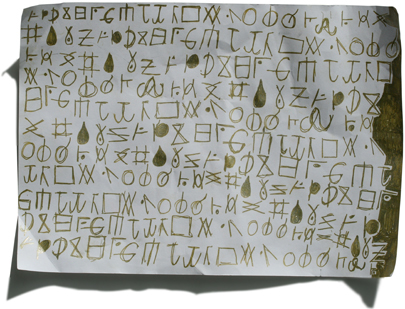
Cate and Lukas at Play: Puffoglyphs

A complete showing of the Puffoglyphs by Lukas, 2012.

A complete showing of the Puffoglyphs by Lukas, 2012.

Cate’s drawing examining the relationship between the “sacred” glyphs O, P and Q, 2012.

Cate’s drawing examining the relationship between the “sacred” glyphs O, P and Q, 2012.

Each of the twenty-six upper- and lowercase letters in our alphabet has a distinct structure, but all are comprised of only four elemental strokes: vertical, horizontal, diagonal, and curvilinear.

It was the Greeks who created this system of standardization approximately 3,500 years ago. In addition to imposing geometric order on the irregular letterforms they adopted from the Phoenicians, the Greeks established the use of a baseline and uniform letterspacing. (It would be another two millennia before the Frankish king Charlemagne mandated the adoption of three additional guidelines still in use today: ascenders, descenders, and a common x-height.)

As a natural extension of their play, our children Cate (age 11) and Lukas (age 8) created a code for their own use they call the Puffoglyphs. They intuitively broke down the Latin alphabet into its four stroke variants and then recombined the component parts to create new, “encoded” typographic forms.

“Elementary letterforms and signs composed of vertical, horizontal, slanted and curvilinear strokes.” Detail from Typography: Formation + Transformation by Willi Kunz.

“Elementary letterforms and signs composed of vertical, horizontal, slanted and curvilinear strokes.” Detail from Typography: Formation + Transformation by Willi Kunz.


American designer Willi Kunz explores the four elemental strokes in his 2003 Typography: Formation + Transformation. Of the illustration we feature from his book, Kunz notes that “Even though the individual forms are abstract, the forms begin to suggest a typographic composition.” The dynamic that Kunz articulates, Cate and Lukas experienced through an act of play. [AW]

+ SHARE Tags Typography/Favorites

25 March, 2013

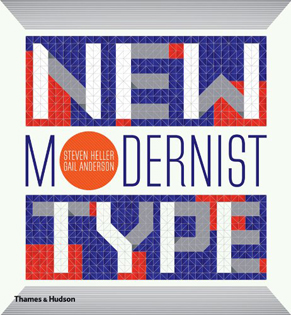
Play Press: New Modernist Type

New Modernist Type

Two of our pieces are featured in Steven Heller’s latest book published by Thames & Hudson. Co-authored with Gail Anderson, New Modernist Type is an international showcase of contemporary graphic design that reinterprets the typographic tenets of Modernism. Perhaps not surprisingly, our work is included in the Meta Modern section which is subtitled “Typography as Icon and Symbol.” Our screen printed poster Getting Upper (see the 14 March, 2011 plog entry) is included, as well as the landing page image of the word “play” from our site, which was photographed by Annie Chen.

+ SHARE Tags Play : Press/Typography

Previous
Next

Tags

  • Recent Posts
  • Play : Work
  • Play : Press
  • Play : School
  • Agitprop
  • Symbols
  • Typography
  • Playmates
  • Favorites
  • Books
  • Book Reviews
  • Interviews
  • Articles
  • Archive

©2026 Design is Play. All Rights Reserved.