Design is Play

  • Work
    • Systems
      • March Pantry
      • CCA DLS X
      • El Pípila
      • Oriel Wines
      • Touchstone Climbing
      • Helix RE
      • Exalt App
      • Intel AppUp
      • Extole
      • CCA Craft Forward
      • Anson Mills
      • Washoe Grill
      • The Buckeye
      • Unhelpful Instructions
      • Design is Play
    • Trademarks
    • Icons
    • Books
      • Symbols
      • Dirty Baby
      • Richter 858
    • Covers
    • Posters
    • Process
  • Play
    • PLOG
      • Recent Posts
      • Play : Work
      • Play : Press
      • Play : School
      • Agitprop
      • Symbols
      • Typography
      • Playmates
      • Favorites
      • Archive
    • Publications
      • Books
      • Articles
    • Press
      • Book Reviews
      • Interviews
    • Shop
  • Meet
    • About Us
    • Clients
    • Awards
    • Contact Us

Recent Posts

11 March, 2013

Angie at Play

Angie Wang’s photographs (1:25)
Amsterdam, Paris, and St. Petersburg, 2004–2007.

Beauty is now underfoot wherever we take the trouble to look. —John Cage

Prior to a trip to Paris in 2004, Mark asked me to return with responses to the following prompts:
The best visual contrast;
The most beautiful piece of type;
The most lush color combination;
The most memorable bite (flavor);
A fifth sensation of note.

These images are the result of what has become an ongoing exercise in my paying attention. Whether with photographs, sketches, or journal entries, I’ve learned to document my travels in an active way because it heightens my awareness of what I see and experience.

Mark and I incorporated a version of this exercise into our 2007 summer study abroad class in Amsterdam. As we stated in our syllabus, “The act of seeing is made more acute by the act of recording.” [AW]
+ SHARE Tags Play : School/Typography/Favorites

4 March, 2013

Design School Wisdom

Our friend and colleague Brooke Johnson from Chronicle Books in San Francisco is working on a new title with Jennifer Tolo Pierce called Design School Wisdom, a compilation of quotes from teachers and students. Brooke asked us to submit some quotes for possible inclusion in the book which we share below.

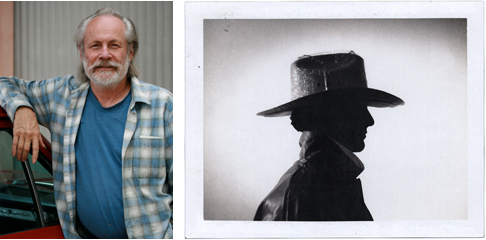
(left) Jeff Wasserman outside his studio in Santa Monica, 2009. (right) Mark Fox photographed by Michael Schwab for one of Michael’s posters, 1986.

(left) Jeff Wasserman outside his studio in Santa Monica, 2009. (right) Mark Fox photographed by Michael Schwab for one of Michael’s posters, 1986.

Being self-taught as a designer, I didn’t attend design school. I did, however, work at a few jobs during and after college that exposed me to some workplace wisdom.

One of my jobs in college—around 1982—was to work for Wasserman Silk Screen Co. in Santa Monica, California. Jeff Wasserman set up the original screen printing shop at Gemini G.E.L. in Los Angeles, and has printed for a number of well-known artists, including Andy Warhol, Ed Ruscha, Robert Rauschenberg, Claus Oldenberg, Frank Stella, and Billy Al Bengston, among others. His work is extremely precise, and he is a master at what he does. Nonetheless, one of the maxims Jeff often uttered to me was, “Don’t make a religious experience out of it.”

A few years later, in 1985, I worked for the designer and illustrator Michael Schwab in San Francisco who is especially well-regarded for his poster work. Michael has always been successful—or so it seemed to me!—and his oft-repeated advice usually followed negotiations with clients. He would say, “There’s always more time and more money.”

This is my twentieth year teaching courses in graphic design at California College of the Arts in San Francisco. I give my students no end of advice, I’m sure, but the one question I continually ask them that seems worth sharing is this: “Where does your eye go?” If you know where the eye goes when you look at work, and why, then you understand true hierarchy—regardless of the design intention. If you remain unaware of hierarchy, of what the eye sees and in what order, your work will remain indistinct and forgettable. [MF]

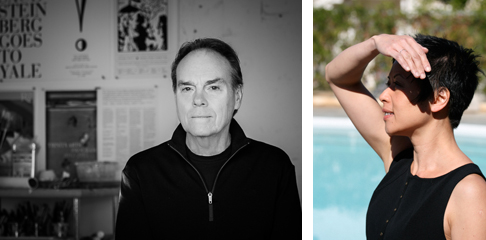
(left) Michael Manwaring photographed by Christopher Manwaring. (right) Angie at the RE:DESIGN / Creative Directors Conference in Palm Springs, 2011. The title of our presentation was “Get Back: Working Analog in a Digital World.”

(left) Michael Manwaring photographed by Christopher Manwaring. (right) Angie at the RE:DESIGN / Creative Directors Conference in Palm Springs, 2011. The title of our presentation was “Get Back: Working Analog in a Digital World.”

If you have to ask the question, you already know the answer. —Michael Manwaring

Michael Manwaring was my Graphic Design 2 instructor at the California College of Arts and Crafts in San Francisco. Michael’s pedagogic model seemed to be based on questioning—he deliberately responded to our questions with more questions. While this resulted in a dialogue of evaluation, it didn’t necessary yield a definitive answer—at least not immediately.

Needless to say it was maddening at the time. Ultimately, though, I learned from Michael how to actively—and critically—distill my ideas and formulate my opinions.

Work hard—the rest will come in time. —Steve Reoutt

I entered the CCAC graphic design program in 1993 and had the good fortune of having Steve Reoutt as one of my first instructors. For Steve, the discipline of working steadily and making progress every day was more important than the “success” of our final work. Steve made us sketch in large pads of newsprint every day, whether we felt like it or not. At the end of every assignment he would take the time to meet with us individually to go through our newsprint pad.

Final crits were led by students: we would put our work up and the students would choose which pieces to critique. More often than not my work would be the last to be chosen for discussion—or sometimes, not at all—leaving Steve to monologue about my project. He always managed to tease out some positive aspect (like the thoughtfulness of my approach) despite the awkward final form.

During one of his reviews of my sketch pad he looked at me and said, “You’re a good problem solver and you work hard. I know form-making doesn’t come easily for you, but no one has it all. Work hard, and the rest will come in time.”

His faith—and the rigor of his approach—had a profound impact on me as a student. It encouraged me to be patient and it allowed me to grow as a designer at my own pace. I have been teaching Typography 1 in the graphic design program at CCA for seven years now and, like Steve, I collect and review my students’ process sketches at the end of every assignment. [AW]

+ SHARE Tags Play : School/Favorites

14 February, 2013

Play at Play: Happy Valentine’s Day!

Love

If love was a train I’d throw my body right down on her tracks. —Michelle Shocked

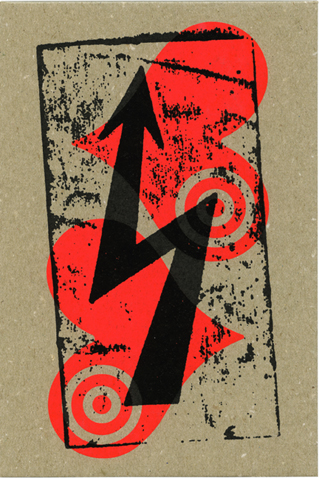
Our most recent labor of love features two hearts with targets juxtaposed with a bolt. We drew the heart glyph; the bolt was lifted from a warning sticker marking high voltage on a Canadian ferry. As we love ink on paper, we screen printed our design on hefty chipboard to render the ephemeral greeting a bit less so.

Kevin Giffen from Wranch Studio in Santa Monica, California, printed the art: two hits (wet on wet) of fluorescent pink followed by one hit of black. Mark worked with Kevin at Wasserman Silk Screen Co. thirty years ago, and we are thrilled to be working with him again. Angie set the Michelle Shocked lyric on the back of the card in Marian Black, a monoline blackletter that we customized for readibility.

+ SHARE Tags Play : Work/Symbols/Favorites

4 February, 2013

Play Press: Typography 33

33rd Annual of The Type Directors Club

We are pleased to note that our March Pantry Packaging System is featured in the 33rd Annual of The Type Directors Club. Of the 1,600 competition entries from 33 countries, 223 were selected for publication by the jury. (The March Pantry Packaging System also appeared in the October 2012 online edition of Wallpaper* Magazine.)

See our work to date for March Pantry under Design is Play Studio Systems.

+ SHARE Tags Play : Press

21 January, 2013

Site Updates

Art Book

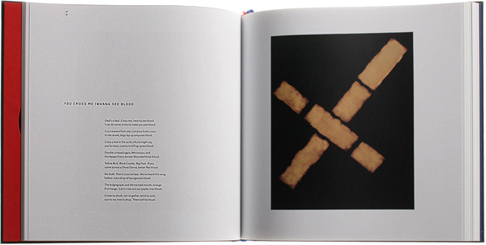
We recently added some work to our site—some new, some old—including the web site we designed for Anson Mills; two art books, one featuring the work of Ed Ruscha and the second featuring the work of Gerhard Richter; and some examples of hand-inked trademarks and typography.

We hope you enjoy!

+ SHARE Tags Play : Work

Previous
Next

Tags

  • Recent Posts
  • Play : Work
  • Play : Press
  • Play : School
  • Agitprop
  • Symbols
  • Typography
  • Playmates
  • Favorites
  • Books
  • Book Reviews
  • Interviews
  • Articles
  • Archive

©2026 Design is Play. All Rights Reserved.