Design is Play

  • Work
    • Systems
      • March Pantry
      • CCA DLS X
      • El Pípila
      • Oriel Wines
      • Touchstone Climbing
      • Helix RE
      • Exalt App
      • Intel AppUp
      • Extole
      • CCA Craft Forward
      • Anson Mills
      • Washoe Grill
      • The Buckeye
      • Unhelpful Instructions
      • Design is Play
    • Trademarks
    • Icons
    • Books
      • Symbols
      • Dirty Baby
      • Richter 858
    • Covers
    • Posters
    • Process
  • Play
    • PLOG
      • Recent Posts
      • Play : Work
      • Play : Press
      • Play : School
      • Agitprop
      • Symbols
      • Typography
      • Playmates
      • Favorites
      • Archive
    • Publications
      • Books
      • Articles
    • Press
      • Book Reviews
      • Interviews
    • Shop
  • Meet
    • About Us
    • Clients
    • Awards
    • Contact Us

Recent Posts

14 February, 2011

Emily McVarish at Play

plog_14.02.11

“A Thousand Several is a letterpress book which I wrote and produced for Granary Books and exhibited at 871 Fine Arts last fall. My plan had been to design A Thousand Several as I went along, printing one element and then responding to that element with a new compositional layer. I had thought this would be a liberating exercise, an alternative to the master planning that books tend to demand, a way to make the most of workshop epiphanies.

“In fact, the process often proved fraught, as I attempted to build a graphic system in the dark. ‘What sort of constraints will I be setting myself if I add this?,’ I kept asking myself, ‘How will the dynamics I’ve established be affected by another component?’ I muddled through, and after a year of printing I had my book. I also had a pile of make-ready sheets and a list of design ideas that had not made it through the gauntlet of unknowns that riddled each stage of A Thousand Several’s production.

“One of those ideas finally led me to play: Using a tabbed die, I cut my make-ready into strips of variable widths that could be combined in more than one way to add up to a standard size. I laid all of the strips out on my work table and set about composing Piece-time, an edition of 50 modular collages. Lifting strips from among hundreds of visible variations, laying them alongside each other, sliding them into different arrangements, I felt like I was playing an instrument. Improvisation came easily. Rhythm more than judgment drove and decided the composition of each print.”

Emily McVarish is a San Francisco writer, designer, book artist, and educator. We invited her to share a moment of play with us.
 

+ SHARE Tags Playmates

7 February, 2011

dress code at Play

plog_07.02.11

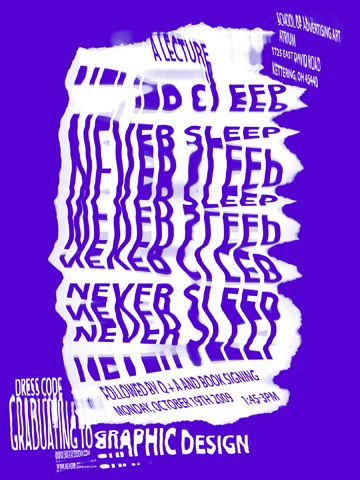
“Our company began out of a shared love for music. We started by collaborating on screen printed posters and package designs for our friends’ bands in college. These jobs never really paid much, if anything, and were more for the fun of making.

“As our business and client list grew, we sadly had less and less time to devote to these projects. Without this creative outlet though, our other work began to get a bit stale.

“To combat the seriousness of corporate clients we started to create a series of one-color screen printed posters to advertise our lectures. We pay to have them printed out-of-pocket, so we have complete creative control. Without the constraints of client approval, the posters have become a way for us to play and experiment.”

Andre Andreev and Dan Covert are New York designers and CCA alumni. We invited them to share a moment of play with us.

+ SHARE Tags Playmates

2 February, 2011

Play at Play

plog_02.02.11

To announce the launch of the Design is Play website, we created a mailing based on the idea of play. Playing card backs are overprinted with an LCD grid to suggest infinite possibilities: depending on which portions of the grid are “lit,” any letter or number can be constructed. The LCD grid as a programmable system is an apt analogy for our studio as well as the web.

Card fronts are overprinted with a “window” which both frames and reframes the original design, forcing the viewer to reconsider the familiar schema. Like the LCD grid, the window suggests a larger idea: a screen with an infinite number of views. The playing cards were foil stamped by Oscar Printing, San Francisco. (Photos by Mark Serr.)

See more playing cards under Design is Play Studio Systems.

+ SHARE Tags Play : Work/Typography

31 January, 2011

Fox on Designers and Books

plog_31.01.11

Launching February 1, Designers and Books is a new website “devoted to publishing lists of books that esteemed members of the design community identify as personally important, meaningful, and formative—books that have shaped their values, their worldview, and their ideas about design.” The site is launching with 678 books recommended by 50 designers; Mark is honored to be among them. His book list includes titles about typography, symbols, comics, and social critique. (Illustration by Ben Shahn from Ounce, Dice, Trice.)

Designers and Books was created by Steve Kroeter who also acts as its Editor-in-Chief. The site was designed by Pentagram.

+ SHARE Tags Favorites

24 January, 2011

Minniti McMurtrie Identity

plog_24.01.11

We designed this identity for San Francisco fashion designer Jennifer Minniti and architect Darren McMurtrie. The letterforms are modeled on Banjo, a titling face released by the French foundry Deberny & Peignot in 1930. The wide versions of the letters provide cues to the pronunciation of their names as they roughly correspond to the stresses. (For example, the first R is held longer than the second R in McMurtrie.)

See more examples of our identity designs under Design is Play Studio Trademarks.

+ SHARE Tags Play : Work/Symbols/Typography

Previous
Next

Tags

  • Recent Posts
  • Play : Work
  • Play : Press
  • Play : School
  • Agitprop
  • Symbols
  • Typography
  • Playmates
  • Favorites
  • Books
  • Book Reviews
  • Interviews
  • Articles
  • Archive

©2026 Design is Play. All Rights Reserved.