Design is Play

  • Work
    • Systems
      • March Pantry
      • CCA DLS X
      • El Pípila
      • Oriel Wines
      • Touchstone Climbing
      • Helix RE
      • Exalt App
      • Intel AppUp
      • Extole
      • CCA Craft Forward
      • Anson Mills
      • Washoe Grill
      • The Buckeye
      • Unhelpful Instructions
      • Design is Play
    • Trademarks
    • Icons
    • Books
      • Symbols
      • Dirty Baby
      • Richter 858
    • Covers
    • Posters
    • Process
  • Play
    • PLOG
      • Recent Posts
      • Play : Work
      • Play : Press
      • Play : School
      • Agitprop
      • Symbols
      • Typography
      • Playmates
      • Favorites
      • Archive
    • Publications
      • Books
      • Articles
    • Press
      • Book Reviews
      • Interviews
    • Shop
  • Meet
    • About Us
    • Clients
    • Awards
    • Contact Us

Recent Posts

7 January, 2013

Play Press: Communication Arts 2013 Typography Annual

Communication Arts 2013 Typography Annual

Savory design: kosher salt jars featuring the March Pantry identity are included in the recent Communication Arts 2013 Typography Annual. (We screen printed our design in metallic ink on glass apothecary jars.) Of the 1,934 competition entries, 154 were selected for publication by the jury.

See our work to date for March Pantry under Design is Play Studio Systems.

+ SHARE Tags Play : Press

11 December, 2012

Play Press: University of California monogram

plog_11.12.12

When the general public became aware that a new UC monogram had been launched to represent the University of California and its ten campuses, San Francisco Chronicle staff writer Carolyn Jones contacted me for an opinion.

Both Angie and I earned degrees from the University of California: Angie has a degree in Japanese from UC Berkeley, and I have a degree in Fine Arts from UCLA. As alumni of the UC system, the new monogram represented us—as well as hundreds of thousands of other alumni, current students, and faculty.

While I understand that the University of California needs a new symbol separate from its historic “seal,” the proposed monogram was not the appropriate solution. Branding statements or strategy documents become moot when the resulting visual identity doesn’t accurately reflect the company or institution, or “speaks” in the wrong “voice.”

The pedagogic approach of the Graphic Design department at the California College of the Arts in San Francisco where we teach is predicated on the idea of critique. Work is judged, publicly. I encourage my students to ask the following questions so that they can determine for themselves the merits of their work. For example:

Who is the audience?
What is the intended message?
Is it the right message?
How successfully does the piece communicate the intended message?
What elements contribute to the piece’s successful communication?
What elements detract from it?
Are there unintended messages?

The San Francisco Chronicle article ran on the front page on Tuesday, December 11, 2012. My comments were offered from the perspective of an instructor who believes that informed, perceptive critique can only sharpen—and thus benefit—the practice of graphic design in our culture. My quotes from the article are below. [MF]

“Utterly forgettable”

Mark Fox, a graphic design professor at California College of the Arts who designed that school’s logo and has done work for UC in the past, panned the new effort.

“The visual language is generic, commercial and utterly forgettable,” he said. “It is a complete mismatch for the university’s history and reputation. (It) has no visual or conceptual gravitas.”

A good logo should be distinct and memorable, create positive associations, reflect well on the company and work easily and inexpensively in all media, he said.

“The new UC logo,” Fox said, “fails in most of the above criteria.”

The entire article by Carolyn Jones can be found here. Three days after the article ran the University of California withdrew its support for the new symbol.

+ SHARE Tags Play : Press/Symbols

12 November, 2012

Volume at Play

“Play manifests in many forms at Volume, but it’s most liberating when we forget the designer dogma and the ‘how design should be’ voice in our heads to produce work that surprises and scares us. It’s a rare occurrence—there are only so many people brave enough to, say, carve a poster into their chest, and I don’t consider myself one of them—but when it happens, I wonder why we can’t repeat the process for every project.

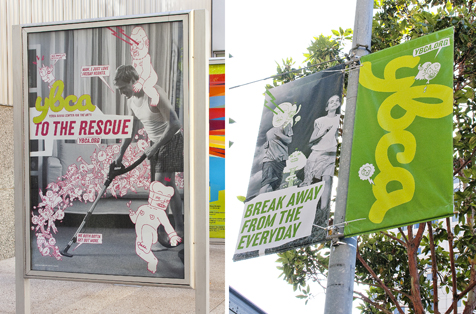
“In 2009, we were lucky enough create a new campaign and visual system for Yerba Buena Center for the Arts (YBCA). YBCA is an organization that prides itself on bucking the status quo and we thought we were doing the same in our initial design explorations. We certainly avoided the stately, clean patina that characterizes so many art institutions, but none truly had the edge YBCA demanded. We were hung up on what cutting-edge design should look like instead of truly infusing the work with the subversive voice YBCA desired.

YBCA1

“We had one idea, though, that did evoke this renegade spirit—and we almost didn’t show it. Would you share an idea that has a cartoon monster straight out of Sponge Bob Square Pants or Futurama lopping off the upper torso of 1950’s-era astronaut? This was late-night comic relief between our serious, heavy-hitter directions. Better to include it, though, to show YBCA we understood them and were willing to get a little crazy. There’s no way they’d pick this direction, right?

YBCA2

“Well, of course they picked it. They loved it. The idea was so dead-on and engaging to them that it transcended its middling execution. Once we got over the shock of YBCA’s selection and began refining, palpable excitement began to overcome us, too. The project felt a bit dangerous and we were giddily nervous on the eve of its public rollout. Swimming in our heads were past remarks from peers deriding humor as a cheap, lowbrow design tactic. Yet here we were, commissioning goofy drawings of Mao and Mr. T superimposed over banal stock photographs while talking about ‘setting one’s life to vibrate.’ We had absolute confidence that the design captured the essence of YBCA, but we sensed that there would be no middle ground responses—people would either love it or hate it.

YBCA3-4

YBCA5

“Interestingly, most non-designers we talked to loved it. The YBCA leadership also unapologetically loved it, even if it’s doubtful their whole staff did. (Who are more serious than design types? Art types.) The designer breakdown was fifty-fifty. Only a few disparaged it outright to our faces, but many were conspicuously quiet. The most unexpected praise came from the Apple store employee who sold me an iPhone and, upon seeing my email address and recognizing the domain from our design credit, gushed how the Third Street wall was his new favorite landmark on his walk to work.

“How often does a good cross-section of the public see, let alone care—let alone react—to what we as designers make? That was the real thrill of this project. Play, then, is also sitting outside at the SFMOMA cafe as YBCA’s upstart wall taunts the more august institution across the street. Play is watching my friends’ kids marvel giddily at the outsized illustrations looming over them. Play is a ‘Set Your Life to Vibrate’ banner coincidentally installed right above Good Vibrations on Valencia Street. Really.”

Eric Heiman is a San Francisco designer and educator, and works with his partner Adam Brodsley at Volume, Inc. We invited Eric to share a moment of play with us.

+ SHARE Tags Playmates

29 October, 2012

Dogpatch Boulders Identity

plog_29.10.12 Dogpatch Boulders Identity

Touchstone Climbing is at it again, this time adding a new bouldering gym in the Dogpatch section of San Francisco, south of downtown. Slated to open in early 2013, the gym will feature prefabricated walls manufactured by the Bulgarian company Walltopia.

Our design is a conceptual no-brainer: dog + “eyepatch” = dogpatch. The colored X behind the dog was created with climbing tape, and reinforces the cruciform design of the dog’s face. Touchstone wanted the new identity to feel “urban.”

See other trademarks we have designed for similar clients under Design is Play Studio Symbols Trademarks Sports and Entertainment.

+ SHARE Tags Play : Work/Symbols

30 July, 2012

Play Press: Graphis New Talent 2012

GD1posterFinal

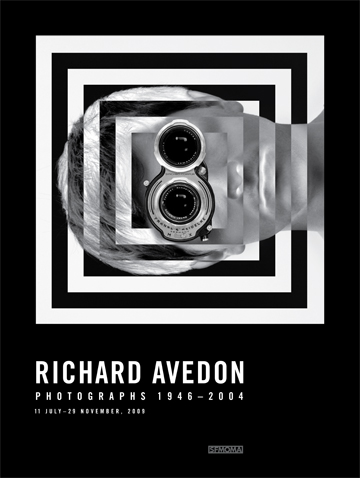
We are always thrilled when our students’ work from CCA is honored by inclusion in an international competition. The recent Graphis New Talent annual features the work of four students from Mark’s “Graphic Design 1: Foundation” class: Amy Compeau, Kelly Kusumoto, Vincent Romero, and May Wong.

One of the winning projects is pictured above: May Wong’s poster for an exhibition of Richard Avedon’s work. According to May, the aesthetic of her poster is “inspired by Avedon’s minimalist black and white portraits. The lens from a Rolleiflex camera becomes a representation of his incisive eye for photography and how he captures his subject’s personality from a different perspective.” We must note that May shot her own photography for this poster, one of the parameters of the assignment.

CCA colleagues Bob Aufuldish and Alysha Naples also had student work selected for publication, and we congratulate them and their students for this honor.

See more examples of student poster design under Design is Play Classroom Posters.

+ SHARE Tags Play : Press/Play : School

Previous
Next

Tags

  • Recent Posts
  • Play : Work
  • Play : Press
  • Play : School
  • Agitprop
  • Symbols
  • Typography
  • Playmates
  • Favorites
  • Books
  • Book Reviews
  • Interviews
  • Articles
  • Archive

©2026 Design is Play. All Rights Reserved.