Design is Play

  • Work
    • Systems
      • March Pantry
      • CCA DLS X
      • El Pípila
      • Oriel Wines
      • Touchstone Climbing
      • Helix RE
      • Exalt App
      • Intel AppUp
      • Extole
      • CCA Craft Forward
      • Anson Mills
      • Washoe Grill
      • The Buckeye
      • Unhelpful Instructions
      • Design is Play
    • Trademarks
    • Icons
    • Books
      • Symbols
      • Dirty Baby
      • Richter 858
    • Covers
    • Posters
    • Process
  • Play
    • PLOG
      • Recent Posts
      • Play : Work
      • Play : Press
      • Play : School
      • Agitprop
      • Symbols
      • Typography
      • Playmates
      • Favorites
      • Archive
    • Publications
      • Books
      • Articles
    • Press
      • Book Reviews
      • Interviews
    • Shop
  • Meet
    • About Us
    • Clients
    • Awards
    • Contact Us

27 January, 2014

CREDO Mobile Iconography

plog_27_JAN_2014

Our friend and colleague Steve Lyons asked us to develop a series of political “issue” icons for CREDO Mobile, San Francisco’s progressive phone company. We are proud CREDO customers, so it was a delight to put our talents to work on behalf of our left-leaning phone carrier. Left to right, top to bottom: Women’s Rights, Universal Healthcare, Peace, Workers’ Rights, Social Justice, Renewable Energy, Economic Justice, Marriage Equality, Environment, Voting Rights, and Workers’ Rights (alternate version).

+ SHARE Tags Play : Work/Symbols

20 January, 2014

Play Press: Animal Logos

plog_20_JAN_2014

The latest book from Counter-Print Press (UK) includes four of our trademarks: Red Herring, The Buckeye, BO.LT, and Eveready Battery. This international collection of 266 animal logos features work from Total Identity, Lance Wyman, Build, Stockholm Design Lab, Minale Tattersfield, Stefan Kanchev, and Kari Piippo Oy, among others.

+ SHARE Tags Play : Press/Symbols

9 September, 2013

CCA Graphic Design Program Avatar

Not that CCA’s Graphic Design Program needed a Facebook avatar, but, what the hell. Here is Mark’s original inking for the surprisingly energetic skull, as well as CCA alumna Nami Kurita displaying the die-cut sticker version of the design on her iPhone. Design or Die!

+ SHARE Tags Play : School/Play : Work/Symbols

22 July, 2013

Play Press: Design Firms Open for Business

Design Firms Open for Business Book

We are pleased to be among the forty-four design firms interviewed for Steven Heller and Lita Talarico’s new book from Allworth Press. Although largely drawn from America—and, in particular, New York—the book is international in scope and includes designers from Australia, Canada, England, Germany, Israel, Italy, Japan, The Netherlands, Slovenia, South Korea, Spain, and Switzerland.

The other San Francisco designer included in Design Firms Open for Business is our CCA colleague Jennifer Morla. (Jennifer is in the “Medium Firms” section; as a two-person entity we qualify as “Small.”)

Download the interview as a PDF.

+ SHARE Tags Play : Press/Typography

1 July, 2013

In Memorium: Irving Oaklander, 1924–2012

(left) Irving Oaklander, proprietor of Oaklander Books in New York City, on December 23, 2010. Irving holds a rare copy of Vladimir Mayakovsky’s 1923 book For the Voice (Dlia Golosa) which was designed by El Lissitsky. (right) Angie holds a page of For the Voice up to the light to reveal the compositional correspondence between pages 17 and 18.

(left) Irving Oaklander, proprietor of Oaklander Books in New York City, on December 23, 2010. Irving holds a rare copy of Vladimir Mayakovsky’s 1923 book “For the Voice” (Dlia Golosa) which was designed by El Lissitsky. (right) Angie holds a page of “For the Voice” up to the light to reveal the compositional correspondence between pages 17 and 18.

Irving was curious and notably generous—two qualities that made him a natural teacher. (Not surprisingly, Irving taught in New York City’s public schools for many years before opening Oaklander Books.) Angie and I were fortunate to spend long hours on two separate occasions in his crowded Chelsea shop poring over his singular collection of design and typography books. Not only did Irving let us handle Mayakovsky’s For the Voice, but also, memorably, one of the Million Mark banknotes designed by Herbert Bayer in 1923.

Although Irving died one year ago this August, Angie and I think of him frequently, especially when Angie brings our type specimens to school to share with her students. Among the letterpress specimen books we bought from Irving are those for Trump-Deutsch (1938) designed by Georg Trump and released by H. Berthold, AG; Ingeborg Antiqua (c. 1909) designed by Professor F.W. Kleukens and released by D. Stempel, AG; and Ehmcke-Mediaeval (1924) designed by F.H. Ehmcke and released by D. Stempel, AG.

(left) A page from the Trump-Deutsch specimen book. (right) The title page from the Ingeborg Antiqua specimen book.

(left) A page from the Trump-Deutsch specimen book. (right) The title page from the Ingeborg Antiqua specimen book.

Steven Heller, who also frequented Oaklander Books, wrote a remembrance of Irving for Print Magazine in August of 2012 which can be read here. Swann Galleries in New York auctioned off some of Irving’s rare books in May of 2013, many of which can be seen in the auction catalog. Incidentally, Irving’s copy of For the Voice sold for $7,500. [MF]

+ SHARE Tags Typography/Favorites

24 June, 2013

John Pappas at Play

John Pappas

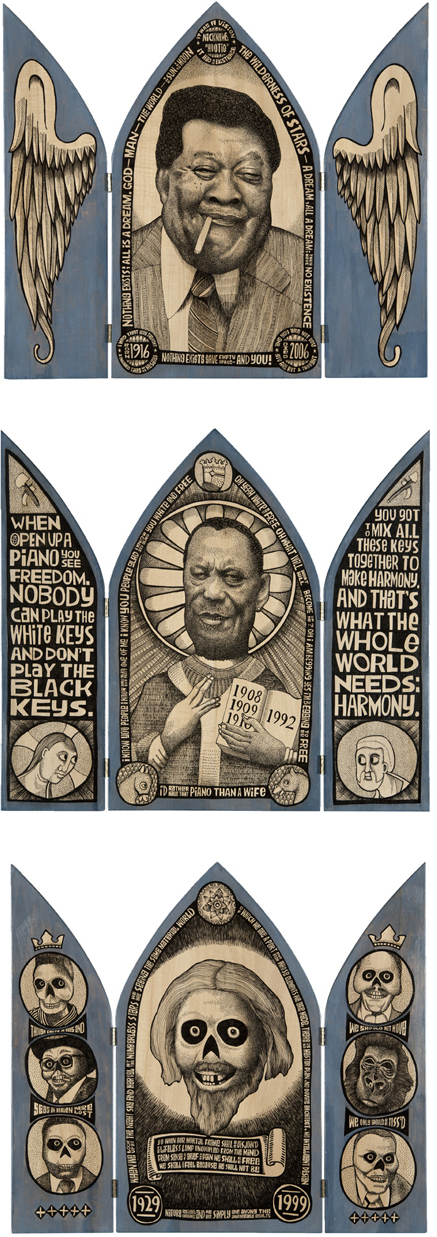
I am an art director and graphic designer in Ann Arbor, Michigan. When I’m done fulfilling my nine-to-five responsibilities I often spend my free time drawing.

In the spring of 2010 I got to know blues and boogie pianist Mark Braun (Mr.B). Our friendship lead to a project that combined Mark’s music and my drawings. Using a Tombow Zoom pen, I drew portraits of sixteen blues and boogie woogie piano legends that had influenced Mark’s playing style and career, some of which he knew personally.

We crafted hinged panels of basswood for each of the bluesmen, a format that wouldn’t need to be framed. To keep the text and images spontaneous and free, no “under drawing” was done. In fact, very little planning or preparation were done before the drawing began.

That can be considered playful, or stupid, depending on one’s perspective. For me, it was probably a reaction to the rigors of my day-to-day art direction and graphic design responsibilities that come with an army of account executives, copywriters, creative directors and clients all pitching in with strategies, objectives, graphic standards, and feedback that can range from the helpful to the puzzling. With this process I simply sat down with some basic reference material and got after as best I could.

Eventually the project came to fruition at Ann Arbor’s Kerrytown Concert House in February of 2012. Mark performed and told stories relating to the musicians portrayed on the artwork displayed in the concert house. In addition, the work has been shown at the Antieau Gallery in New Orleans.

John Pappas is a Michigan-based art director and designer. We invited him to share a moment of play with us.

+ SHARE Tags Playmates

10 June, 2013

Play Press: Design: Portfolio

Design: Portfolio

Two of our self-promotional pieces are included in this new book published by Rockport and authored by Craig Welsh. Design: Portfolio features our web announcement for the Design is Play site—foil stamped on playing cards by Frank La at Oscar Printing—and our 2010 New Year’s card—letterpress printed by Chip Forman, now at The Ligature.

Both of these projects can be seen at Design is Play Studio Systems.

+ SHARE Tags Play : Press/Typography

20 May, 2013

Play Press: Graphis Design Annual 2013

Graphis Design Annual 2013

Our March Pantry Packaging System received a Gold award in the new Graphis Design Annual—a full page is devoted to our oil and vinegar packaging for the San Francisco retailer. We are one of only 70 firms featured, and are proud to be in the company of our friends and colleagues Michael Vanderbyl, Kit Hinrichs, and Michael Schwab.

See our work to date for March Pantry under Design is Play Studio Systems.

+ SHARE Tags Play : Press

8 April, 2013

Beware of Dog: Embarko, Twenty-Four Years Later

Embarko

The San Francisco restaurant Embarko opened in 1989 when I was twenty-eight. Slated to be called Trudy’s after the owners’ dog, I was so uninspired by the name that I proposed multiple alternatives, Embarko among them. The new name referenced both the restaurant’s bayside location on the Embarcadero as well as the owners’ canine empathies.

The Embarko trademark takes the form of a rebus which requires the reader to decode conventional symbols of language—letters of the alphabet—in the company of a pictorial element representing sound. Inherently playful, the rebus is common to children’s puzzles but is less frequently found in trademarks. (One notable exception: Milton Glaser’s 1977 I♥NY.) An important development in the history of writing, the rebus is believed to have been invented by the Sumerians around 3000 BCE and subsequently adopted by the Egyptians.

My intention was to render the dog (which represents the onomatopoetic sound “bark”) as a glyph to visually approximate typography. I began by setting the letters E, M, and O in Raleigh Gothic Condensed, a geometric sans serif designed by M.F. Benton for the American Type Foundry (ATF) in 1932. By matching the stroke weights of the dog to those of the letterforms, the dog visually groups with and “reads” like the text. Happily, the dog’s “bark” also corresponds with the natural stress of the restaurant’s pronunciation: Em-bark-o.

The yellow Post-It note shows my original sketches for the trademark. I ultimately hand-inked the dog and rule with a Rapidograph technical pen; the type was set on a typositor by the San Francisco office of Andresen Typographics. Final art was a black and white “stat.”

My work for Embarko was selected for inclusion in the American Institute of Graphic Arts’ “Under 30” national competition in 1990. Some of the other young designers whose work was represented in “Under 30” includes Carol Devine Carson, Chip Kidd, and Alexander Isley. [MF]

See the Embarko rebus under Design is Play Studio Symbols Trademarks Food & Drink.

+ SHARE Tags Symbols/Typography

1 April, 2013

Cate and Lukas at Play: Puffoglyphs

A complete showing of the Puffoglyphs by Lukas, 2012.

A complete showing of the Puffoglyphs by Lukas, 2012.

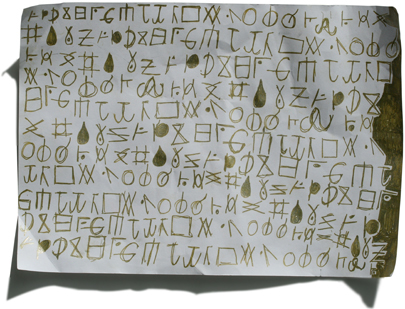
Cate’s drawing examining the relationship between the “sacred” glyphs O, P and Q, 2012.

Cate’s drawing examining the relationship between the “sacred” glyphs O, P and Q, 2012.

Each of the twenty-six upper- and lowercase letters in our alphabet has a distinct structure, but all are comprised of only four elemental strokes: vertical, horizontal, diagonal, and curvilinear.

It was the Greeks who created this system of standardization approximately 3,500 years ago. In addition to imposing geometric order on the irregular letterforms they adopted from the Phoenicians, the Greeks established the use of a baseline and uniform letterspacing. (It would be another two millennia before the Frankish king Charlemagne mandated the adoption of three additional guidelines still in use today: ascenders, descenders, and a common x-height.)

As a natural extension of their play, our children Cate (age 11) and Lukas (age 8) created a code for their own use they call the Puffoglyphs. They intuitively broke down the Latin alphabet into its four stroke variants and then recombined the component parts to create new, “encoded” typographic forms.

“Elementary letterforms and signs composed of vertical, horizontal, slanted and curvilinear strokes.” Detail from Typography: Formation + Transformation by Willi Kunz.

“Elementary letterforms and signs composed of vertical, horizontal, slanted and curvilinear strokes.” Detail from Typography: Formation + Transformation by Willi Kunz.


American designer Willi Kunz explores the four elemental strokes in his 2003 Typography: Formation + Transformation. Of the illustration we feature from his book, Kunz notes that “Even though the individual forms are abstract, the forms begin to suggest a typographic composition.” The dynamic that Kunz articulates, Cate and Lukas experienced through an act of play. [AW]

+ SHARE Tags Typography/Favorites

25 March, 2013

Play Press: New Modernist Type

New Modernist Type

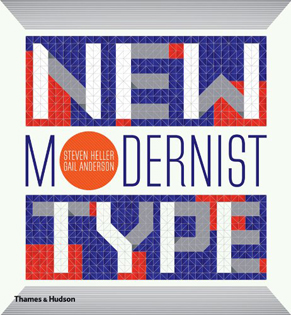
Two of our pieces are featured in Steven Heller’s latest book published by Thames & Hudson. Co-authored with Gail Anderson, New Modernist Type is an international showcase of contemporary graphic design that reinterprets the typographic tenets of Modernism. Perhaps not surprisingly, our work is included in the Meta Modern section which is subtitled “Typography as Icon and Symbol.” Our screen printed poster Getting Upper (see the 14 March, 2011 plog entry) is included, as well as the landing page image of the word “play” from our site, which was photographed by Annie Chen.

+ SHARE Tags Play : Press/Typography

11 March, 2013

Angie at Play

Angie Wang’s photographs (1:25)
Amsterdam, Paris, and St. Petersburg, 2004–2007.

Beauty is now underfoot wherever we take the trouble to look. —John Cage

Prior to a trip to Paris in 2004, Mark asked me to return with responses to the following prompts:
The best visual contrast;
The most beautiful piece of type;
The most lush color combination;
The most memorable bite (flavor);
A fifth sensation of note.

These images are the result of what has become an ongoing exercise in my paying attention. Whether with photographs, sketches, or journal entries, I’ve learned to document my travels in an active way because it heightens my awareness of what I see and experience.

Mark and I incorporated a version of this exercise into our 2007 summer study abroad class in Amsterdam. As we stated in our syllabus, “The act of seeing is made more acute by the act of recording.” [AW]

+ SHARE Tags Play : School/Typography/Favorites

4 March, 2013

Design School Wisdom

Our friend and colleague Brooke Johnson from Chronicle Books in San Francisco is working on a new title with Jennifer Tolo Pierce called Design School Wisdom, a compilation of quotes from teachers and students. Brooke asked us to submit some quotes for possible inclusion in the book which we share below.

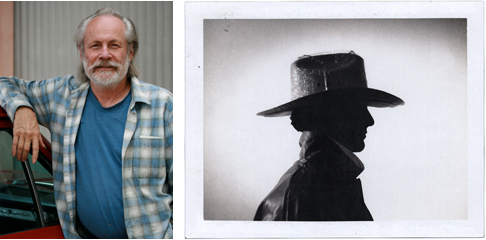
(left) Jeff Wasserman outside his studio in Santa Monica, 2009. (right) Mark Fox photographed by Michael Schwab for one of Michael’s posters, 1986.

(left) Jeff Wasserman outside his studio in Santa Monica, 2009. (right) Mark Fox photographed by Michael Schwab for one of Michael’s posters, 1986.

Being self-taught as a designer, I didn’t attend design school. I did, however, work at a few jobs during and after college that exposed me to some workplace wisdom.

One of my jobs in college—around 1982—was to work for Wasserman Silk Screen Co. in Santa Monica, California. Jeff Wasserman set up the original screen printing shop at Gemini G.E.L. in Los Angeles, and has printed for a number of well-known artists, including Andy Warhol, Ed Ruscha, Robert Rauschenberg, Claus Oldenberg, Frank Stella, and Billy Al Bengston, among others. His work is extremely precise, and he is a master at what he does. Nonetheless, one of the maxims Jeff often uttered to me was, “Don’t make a religious experience out of it.”

A few years later, in 1985, I worked for the designer and illustrator Michael Schwab in San Francisco who is especially well-regarded for his poster work. Michael has always been successful—or so it seemed to me!—and his oft-repeated advice usually followed negotiations with clients. He would say, “There’s always more time and more money.”

This is my twentieth year teaching courses in graphic design at California College of the Arts in San Francisco. I give my students no end of advice, I’m sure, but the one question I continually ask them that seems worth sharing is this: “Where does your eye go?” If you know where the eye goes when you look at work, and why, then you understand true hierarchy—regardless of the design intention. If you remain unaware of hierarchy, of what the eye sees and in what order, your work will remain indistinct and forgettable. [MF]

(left) Michael Manwaring photographed by Christopher Manwaring. (right) Angie at the RE:DESIGN / Creative Directors Conference in Palm Springs, 2011. The title of our presentation was “Get Back: Working Analog in a Digital World.”

(left) Michael Manwaring photographed by Christopher Manwaring. (right) Angie at the RE:DESIGN / Creative Directors Conference in Palm Springs, 2011. The title of our presentation was “Get Back: Working Analog in a Digital World.”

If you have to ask the question, you already know the answer. —Michael Manwaring

Michael Manwaring was my Graphic Design 2 instructor at the California College of Arts and Crafts in San Francisco. Michael’s pedagogic model seemed to be based on questioning—he deliberately responded to our questions with more questions. While this resulted in a dialogue of evaluation, it didn’t necessary yield a definitive answer—at least not immediately.

Needless to say it was maddening at the time. Ultimately, though, I learned from Michael how to actively—and critically—distill my ideas and formulate my opinions.

Work hard—the rest will come in time. —Steve Reoutt

I entered the CCAC graphic design program in 1993 and had the good fortune of having Steve Reoutt as one of my first instructors. For Steve, the discipline of working steadily and making progress every day was more important than the “success” of our final work. Steve made us sketch in large pads of newsprint every day, whether we felt like it or not. At the end of every assignment he would take the time to meet with us individually to go through our newsprint pad.

Final crits were led by students: we would put our work up and the students would choose which pieces to critique. More often than not my work would be the last to be chosen for discussion—or sometimes, not at all—leaving Steve to monologue about my project. He always managed to tease out some positive aspect (like the thoughtfulness of my approach) despite the awkward final form.

During one of his reviews of my sketch pad he looked at me and said, “You’re a good problem solver and you work hard. I know form-making doesn’t come easily for you, but no one has it all. Work hard, and the rest will come in time.”

His faith—and the rigor of his approach—had a profound impact on me as a student. It encouraged me to be patient and it allowed me to grow as a designer at my own pace. I have been teaching Typography 1 in the graphic design program at CCA for seven years now and, like Steve, I collect and review my students’ process sketches at the end of every assignment. [AW]

+ SHARE Tags Play : School/Favorites

1 March, 2013

Design Firms Open for Business

DesignFirms_Heller
DOWNLOAD
“Design is Play”
by Steven Heller and Lita Talarico
Design Firms Open for Business
Allworth Press, 2013

+ SHARE Tags Interviews

14 February, 2013

Play at Play: Happy Valentine’s Day!

Love

If love was a train I’d throw my body right down on her tracks. —Michelle Shocked

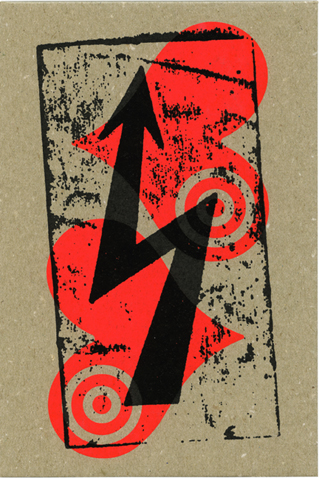
Our most recent labor of love features two hearts with targets juxtaposed with a bolt. We drew the heart glyph; the bolt was lifted from a warning sticker marking high voltage on a Canadian ferry. As we love ink on paper, we screen printed our design on hefty chipboard to render the ephemeral greeting a bit less so.

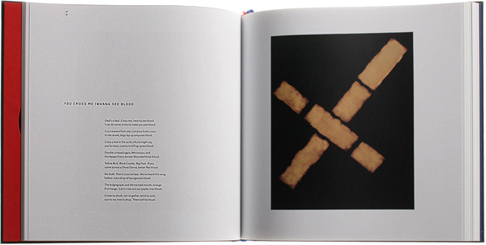
Kevin Giffen from Wranch Studio in Santa Monica, California, printed the art: two hits (wet on wet) of fluorescent pink followed by one hit of black. Mark worked with Kevin at Wasserman Silk Screen Co. thirty years ago, and we are thrilled to be working with him again. Angie set the Michelle Shocked lyric on the back of the card in Marian Black, a monoline blackletter that we customized for readibility.

+ SHARE Tags Play : Work/Symbols/Favorites

4 February, 2013

Play Press: Typography 33

33rd Annual of The Type Directors Club

We are pleased to note that our March Pantry Packaging System is featured in the 33rd Annual of The Type Directors Club. Of the 1,600 competition entries from 33 countries, 223 were selected for publication by the jury. (The March Pantry Packaging System also appeared in the October 2012 online edition of Wallpaper* Magazine.)

See our work to date for March Pantry under Design is Play Studio Systems.

+ SHARE Tags Play : Press

21 January, 2013

Site Updates

Art Book

We recently added some work to our site—some new, some old—including the web site we designed for Anson Mills; two art books, one featuring the work of Ed Ruscha and the second featuring the work of Gerhard Richter; and some examples of hand-inked trademarks and typography.

We hope you enjoy!

+ SHARE Tags Play : Work

7 January, 2013

Play Press: Communication Arts 2013 Typography Annual

Communication Arts 2013 Typography Annual

Savory design: kosher salt jars featuring the March Pantry identity are included in the recent Communication Arts 2013 Typography Annual. (We screen printed our design in metallic ink on glass apothecary jars.) Of the 1,934 competition entries, 154 were selected for publication by the jury.

See our work to date for March Pantry under Design is Play Studio Systems.

+ SHARE Tags Play : Press

11 December, 2012

Play Press: University of California monogram

plog_11.12.12

When the general public became aware that a new UC monogram had been launched to represent the University of California and its ten campuses, San Francisco Chronicle staff writer Carolyn Jones contacted me for an opinion.

Both Angie and I earned degrees from the University of California: Angie has a degree in Japanese from UC Berkeley, and I have a degree in Fine Arts from UCLA. As alumni of the UC system, the new monogram represented us—as well as hundreds of thousands of other alumni, current students, and faculty.

While I understand that the University of California needs a new symbol separate from its historic “seal,” the proposed monogram was not the appropriate solution. Branding statements or strategy documents become moot when the resulting visual identity doesn’t accurately reflect the company or institution, or “speaks” in the wrong “voice.”

The pedagogic approach of the Graphic Design department at the California College of the Arts in San Francisco where we teach is predicated on the idea of critique. Work is judged, publicly. I encourage my students to ask the following questions so that they can determine for themselves the merits of their work. For example:

Who is the audience?
What is the intended message?
Is it the right message?
How successfully does the piece communicate the intended message?
What elements contribute to the piece’s successful communication?
What elements detract from it?
Are there unintended messages?

The San Francisco Chronicle article ran on the front page on Tuesday, December 11, 2012. My comments were offered from the perspective of an instructor who believes that informed, perceptive critique can only sharpen—and thus benefit—the practice of graphic design in our culture. My quotes from the article are below. [MF]

“Utterly forgettable”

Mark Fox, a graphic design professor at California College of the Arts who designed that school’s logo and has done work for UC in the past, panned the new effort.

“The visual language is generic, commercial and utterly forgettable,” he said. “It is a complete mismatch for the university’s history and reputation. (It) has no visual or conceptual gravitas.”

A good logo should be distinct and memorable, create positive associations, reflect well on the company and work easily and inexpensively in all media, he said.

“The new UC logo,” Fox said, “fails in most of the above criteria.”

The entire article by Carolyn Jones can be found here. Three days after the article ran the University of California withdrew its support for the new symbol.

+ SHARE Tags Play : Press/Symbols

12 November, 2012

Volume at Play

“Play manifests in many forms at Volume, but it’s most liberating when we forget the designer dogma and the ‘how design should be’ voice in our heads to produce work that surprises and scares us. It’s a rare occurrence—there are only so many people brave enough to, say, carve a poster into their chest, and I don’t consider myself one of them—but when it happens, I wonder why we can’t repeat the process for every project.

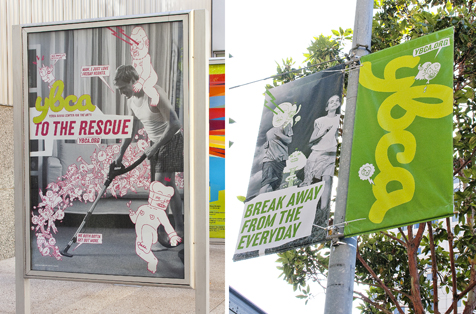
“In 2009, we were lucky enough create a new campaign and visual system for Yerba Buena Center for the Arts (YBCA). YBCA is an organization that prides itself on bucking the status quo and we thought we were doing the same in our initial design explorations. We certainly avoided the stately, clean patina that characterizes so many art institutions, but none truly had the edge YBCA demanded. We were hung up on what cutting-edge design should look like instead of truly infusing the work with the subversive voice YBCA desired.

YBCA1

“We had one idea, though, that did evoke this renegade spirit—and we almost didn’t show it. Would you share an idea that has a cartoon monster straight out of Sponge Bob Square Pants or Futurama lopping off the upper torso of 1950’s-era astronaut? This was late-night comic relief between our serious, heavy-hitter directions. Better to include it, though, to show YBCA we understood them and were willing to get a little crazy. There’s no way they’d pick this direction, right?

YBCA2

“Well, of course they picked it. They loved it. The idea was so dead-on and engaging to them that it transcended its middling execution. Once we got over the shock of YBCA’s selection and began refining, palpable excitement began to overcome us, too. The project felt a bit dangerous and we were giddily nervous on the eve of its public rollout. Swimming in our heads were past remarks from peers deriding humor as a cheap, lowbrow design tactic. Yet here we were, commissioning goofy drawings of Mao and Mr. T superimposed over banal stock photographs while talking about ‘setting one’s life to vibrate.’ We had absolute confidence that the design captured the essence of YBCA, but we sensed that there would be no middle ground responses—people would either love it or hate it.

YBCA3-4

YBCA5

“Interestingly, most non-designers we talked to loved it. The YBCA leadership also unapologetically loved it, even if it’s doubtful their whole staff did. (Who are more serious than design types? Art types.) The designer breakdown was fifty-fifty. Only a few disparaged it outright to our faces, but many were conspicuously quiet. The most unexpected praise came from the Apple store employee who sold me an iPhone and, upon seeing my email address and recognizing the domain from our design credit, gushed how the Third Street wall was his new favorite landmark on his walk to work.

“How often does a good cross-section of the public see, let alone care—let alone react—to what we as designers make? That was the real thrill of this project. Play, then, is also sitting outside at the SFMOMA cafe as YBCA’s upstart wall taunts the more august institution across the street. Play is watching my friends’ kids marvel giddily at the outsized illustrations looming over them. Play is a ‘Set Your Life to Vibrate’ banner coincidentally installed right above Good Vibrations on Valencia Street. Really.”

Eric Heiman is a San Francisco designer and educator, and works with his partner Adam Brodsley at Volume, Inc. We invited Eric to share a moment of play with us.

+ SHARE Tags Playmates

Tags

  • Recent Posts
  • Play : Work
  • Play : Press
  • Play : School
  • Agitprop
  • Symbols
  • Typography
  • Playmates
  • Favorites
  • Books
  • Book Reviews
  • Interviews
  • Articles
  • Archive
Older
Newer

©2026 Design is Play. All Rights Reserved.