Design is Play

  • Work
    • Systems
      • March Pantry
      • CCA DLS X
      • El Pípila
      • Oriel Wines
      • Touchstone Climbing
      • Helix RE
      • Exalt App
      • Intel AppUp
      • Extole
      • CCA Craft Forward
      • Anson Mills
      • Washoe Grill
      • The Buckeye
      • Unhelpful Instructions
      • Design is Play
    • Trademarks
    • Icons
    • Books
      • Symbols
      • Dirty Baby
      • Richter 858
    • Covers
    • Posters
    • Process
  • Play
    • PLOG
      • Recent Posts
      • Play : Work
      • Play : Press
      • Play : School
      • Agitprop
      • Symbols
      • Typography
      • Playmates
      • Favorites
      • Archive
    • Publications
      • Books
      • Articles
    • Press
      • Book Reviews
      • Interviews
    • Shop
  • Meet
    • About Us
    • Clients
    • Awards
    • Contact Us

9 March, 2015

Fox/BlackDog Acquired by LACMA

©DesignisPlay Mark Fox Posters

Two posters Mark designed in the 1990’s were recently acquired by the Los Angeles County Museum of Art as part of the Marc Treib Collection. Treib is professor emeritus of architecture at the University of California, Berkeley, and his gift of over 500 posters now forms part of the Decorative Arts and Design collection at LACMA.

“5ive Iconoclasts” (left) is an offset litho poster promoting a series of lectures from the same year. The 1995 AIGA/SFMOMA Design Lecture Series featured an eclectic mix of designers and artists which included Tibor Kalman (M&Co.), Vaughan Oliver (v23), the Guerrilla Girls, Jenny Holzer, and Diller + Scofidio. The poster quotes Russian poet Vladimir Mayakovsky: “Art is not a mirror to reflect the world, but a hammer with which to shape it.”

“Republican Contract on America” (right) is a 1995 propaganda poster screen printed on chipboard. A quote by Nazi Hermann Göring is used to highlight the anti-intellectual, anti-cultural stance of the Republican-controlled 104th U.S. Congress.

See other agitprop posters at BlackDog.

+ SHARE Tags Play : Press/Symbols/Agitprop

9 February, 2015

Cliffs of Id Identity

©DesignisPlay Cliffs of ID

Cliffs of Id is a new climbing gym from Touchstone Climbing opening in Culver City, California. It is named after a passage in Reyner Banham’s Four Ecologies of Los Angeles, a book about Southern California and its architecture: “The Plains of Id are where the crudest urban lusts and most fundamental aspirations are created, manipulated and, with luck, satisfied.”

The Cliffs of Id symbol is a winged robot, an encapsulation of the mythic future as promised to America by the movie and television industries of Southern California in the 1950’s and 60’s. Like most of our trademark work, we inked this symbol by hand prior to rebuilding it in Illustrator. The wordmark is set in a 17 Oblong, an architectural typeface by Dutch designers René Knip and Janno Hahn at Arktype.

+ SHARE Tags Play : Work/Symbols

19 January, 2015

Judd Foundation, 101 Spring Street

©DesignisPlay

We were fortunate to be in New York in January where we visited the Judd Foundation in SoHo for the first time. The five-story cast-iron building was purchased by Donald Judd in 1968 as a home, studio, and permanent installation. The ground floor features a 1986 minimalist installation by Carl Andre titled Manifest Destiny which consists of eight stacked bricks, all bearing the legend “Empire.”

The third floor of the building houses Judd’s former studio which was perhaps our favorite space. The studio is comprised of three separate areas for activities that correspond to three distinct body positions: chairs for reading while sitting; a desk for drawing while standing; and a floor rug and wooden headrest for contemplation while recumbent.

Judd’s reductive arrangement of space within the studio and his prescription for a specific, different physical orientation while engaged in each task would no doubt serve to focus his attention and separate each creative endeavor in his consciousness. Daniel J. Boorstin, the author of The Image: a Guide to Pseudo Events in America, warns against the unconscious blurring of experience. Addressing technology and the “rise of images” in particular, he writes: “In twentieth-century America we have gone one step beyond the homogenizing of experience…. Even as we try to sharpen our artificial distinctions they become ever more blurry.”

Milton Glaser notes that “Drawing is thinking,” an observation I am fond of quoting. That said, the experience of being in Donald Judd’s studio leads me to an oppositional thought, which is: reading is not drawing is not thinking. While I still subscribe to Glaser’s dictum, I admire Judd’s implicit acknowledgment that while these three activities are related, they are not equivalent. The discipline (and clarity) demanded by Judd’s approach is revelatory. [MF]

+ SHARE Tags Favorites

12 January, 2015

Wang Judges Austin ADDYs

plog_12_JAN_2015

Angie recently served as a juror for the Austin, Texas leg of the American Advertising Awards’ 2015 Competition. This is the first of a three-tier competition—winners move on to a regional and then national competition.

Thank you to Bart Cleveland for this honor!

+ SHARE Tags Play : Press

15 December, 2014

Odile Redon’s The Birth of Venus

The Birth of Venus

While researching the symbolism of the shell for our (ongoing!) book project, we stumbled on an intriguing visual juxtaposition we thought we would share.

The goddess of love emerges from a seashell in The Birth of Venus by French painter Odilon Redon, c. 1912. Originating in the ocean, the shell shares water’s associations with creation and procreation, genetrix and matrix. Combined with physical characteristics which can suggest female genitalia, the shell is an emblem of fecundity and life and, by extension, felicity and prosperity.

Redon’s rendering of the shell’s elliptical silhouette and luminous interior creates a nimbus-like effect similar to the mandorla found in religious icons of the Virgin Mary or the Christ. (The lunate rim of the shell also echoes the crescent moon on which the Virgin often sits or stands.) The detail on the left is from a 13th century Byzantine manuscript in the collection of the J. Paul Getty Museum, Los Angeles.

Like the early Christian almond-shaped aureole, Redon’s seashell is maternal womb, life, light, and utterly sacred. [MF]

+ SHARE Tags Play : Work/Symbols/Favorites

24 November, 2014

Arcsine Identity

©DesignisPlay Arcsine Logo

The dimensional nature of this lowercase letter “a” monogram—comprising surface, volume, interior, and exterior—speaks to Arcsine’s comprehensive architectural practice. The subtext of this design is one of perception and, by extension, vision. The Arcsine wordmark is based on a face by Swiss designer Walter Käch and published in his book Schriften Lettering Ecritures in 1949.

The design of the Arcsine monogram came through an iterative sketching process. The form of the letter originates in the triskelion, an ancient “three-legged” glyph that symbolized progress and victory to the Greeks.

+ SHARE Tags Play : Work/Symbols/Typography

27 October, 2014

Mission Cliffs Applications

Mission Cliffs Applications

In his 1952 essay “On Trademarks,” Herbert Bayer refers to the trademark as a form of “pictorial stenography.” A good trademark is glyphic, and functions as visual shorthand for the client’s product or service. Our MC monogram for Mission Cliffs in San Francisco exemplifies this approach.

As I tell my students at CCA, the trick is to create a mark that is simultaneously simple but distinctive; that reproduces well in one color at less than half an inch, but that nonetheless pulls the eye and engages the mind. Here are two applications of the Mission Cliffs identity at extreme scales in size: lit signage above street level, and dumbbells.

A warm “thank you” to former student Sarah Devyani King for letting us use her photo of our signage! [MF]

+ SHARE Tags Play : Work/Symbols/Typography

15 September, 2014

Mission Cliffs Monogram

Mission Cliffs

We are proud to have been given the opportunity to redesign the identity of our favorite climbing gym, Mission Cliffs in San Francisco. Housed in a former foundry, the gym has an urban, industrial feel: concrete floors, steel I-beams, and a massive crane hook with the hand painted legend “20 tons of capacity.”

We thought the identity should feel empathetic with the space and so relied on simple, constructed forms. (The MC monogram is the kind of no-nonsense trademark that could be stamped out of metal, or stenciled on a machine.) The hexagonal silhouette is a reference to the bolts that are used in both indoor and some outdoor climbing to fasten anchors to the wall; the arrow both reinforces the hexagon and suggests the idea of up!

Pictured with the final design is our second inking of the monogram which is around 5 3/4 inches wide.

+ SHARE Tags Play : Work/Symbols

8 September, 2014

Fox at the Denver Art Museum

Kinder Gentler Carpet Bombing

One of my political posters, “Kinder, Gentler, Carpet Bombing,” is now on view in the exhibition “Drawn to Action: Posters from the AIGA Design Archives.” Culled from the AIGA Design Archives at the Denver Art Museum, the 33 posters in this exhibition “demonstrate the inventive techniques designers use to provoke action.”

I designed “Kinder, Gentler, Carpet Bombing” to question the first U.S./Iraq War in 1990, and distributed the poster via fax to a few friends and colleagues. I also hung it in the windows of my house, studio, and car. (The “GTO” designation in the lower right-hand corner is an abbreviation for Graphic Terrorist Organization, a name suggested by Seattle designer Art Chantry.) This poster is also in the collection of the United States Library of Congress, Prints and Photographs Division. [MF]

See other agitprop posters at BlackDog.

+ SHARE Tags Play : Press/Agitprop

18 August, 2014

Design is Play Archive

Justin Holbrook’s 2008 recontextualization of the classic fairytale Hansel and Gretel

Our original (non-responsive) Design is Play website is now accessible at designisplay/archive. This older site includes work from many of our former CCA students featured in projects from Angie’s Type 1 class and Mark’s Graphic Design 1 class. Student work can be found in the Classroom section of the site.

Pictured above are two spreads from Justin Holbrook’s 2008 recontextualization of the classic fairytale Hansel and Gretel.

+ SHARE Tags Play : School/Symbols/Typography

4 August, 2014

Design is Play Morphs!

What did Angie do this summer? Redesign our site so that it is responsive! (Mark wisely watched from a safe distance.) Our heartfelt thanks to web developer Paul Davidson and designer (and CCA Alumna) Heidi Reifenstein for helping us bring Angie’s design to life. 

Our intern, Mystique, also provided invaluable assistance with this fluid medium.

+ SHARE Tags Play : Work

14 July, 2014

Play Press: Graphis Design Annual 2015

plog_14_JUL_2014

We are proud to note that our trademark for Dogpatch Boulders in San Francisco will be included in the forthcoming Graphis Design Annual 2015, “a collection of the year’s best work from top designers in the industry.” Our mark is a conceptual no-brainer: dog + “eyepatch” = Dogpatch. The colored X behind the dog was created with climbing tape, and reinforces the cruciform design of the dog’s face. In effect, we created a visual mnemonic for the gym.

Of the nine rock climbing gyms that our client owns, this design has proved to be the most popular with the public. They sell more shirts with the Dogpatch identity on it than any of their other gyms. Woof!

+ SHARE Tags Play : Press/Symbols

16 June, 2014

Wang at Communication Arts

plog_16_JUN_2014

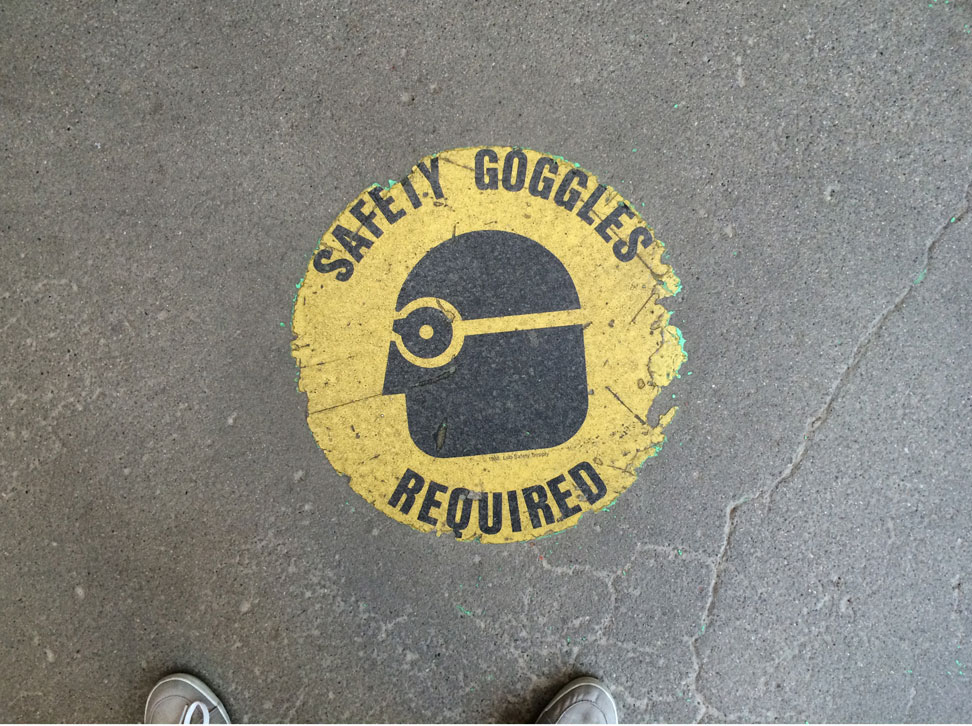
Angie recently served as a juror for Communication Arts’ 2014 Design Competition—thank you Patrick and Jean Coyne for this honor! Angie arm wrestled fellow designers Stefan G. Bucher, Jo Davison, Fritz Klaetke, and Eric Thoelke to cull the entries down to the glorious few. (CA’s safety notice notwithstanding, goggles were not required.)

+ SHARE Tags Play : Press

21 April, 2014

Play Press: Design School Wisdom

plog_21_APR_2014

We are pleased to have some of our “wisdom” anthologized in this new offering from Chronicle Books which is edited by Brooke Johnson and Jennifer Tolo Pierce. Angie recalls what she learned from her first graphic design instructor at CCA, Steve Reoutt; Mark offers some simple advice about hierarchy. You can read our comments (as well as others we shared with Brooke) in one of our earlier plog posts from 4 March, 2013.

The views of many of our colleagues from CCA are represented in Design School Wisdom, including Bob Aufuldish, Leslie Becker, Rachel Berger, Dennis Crowe, Melanie Doherty, Eric Heiman, Emily McVarish, and Michael Vanderbyl. (Co-editor Brooke Johnson has taught at CCA as well.)

+ SHARE Tags Play : Press/Play : School

14 April, 2014

René Knip at CCA, 4.10.2014

plog_14_APR_2014

René at his Saturday workshop with CCA students, “The Architectural Letter.”

In town for the TYPO conference, we had the pleasure of bringing Dutch designer and typographer René Knip to California College of the Arts to give a lecture to CCA’s graphic design students and faculty. I had the honor of introducing René prior to his lecture; what follows are excerpts from my remarks:

René has a fierce love of typographic forms, and this love is most often expressed in a material—and spatial—context. In a 2011 interview, René said: “I use letters like a photographer does a camera: I use them to illustrate emotions.”

These emotions are evoked by a typography that is liberated from the page and screen and made manifest in the physical world. It joyfully inhabits this world, interacting with it: René’s letters move, cast shadows, get wet, and age. Whether formed of water cut steel, milled aluminum, sand-blasted stone, or ceramic tile, René consistently creates typography with a monumental presence that is nonetheless idiosyncratic and personal. His is a typography with a point of view.

René Knip studied graphic design at the Academy of Visual Arts St. Joost, Breda, where he worked under type designer Chris Brand, perhaps best known for the face Albertina. On graduation, Knip worked for three years as the assistant designer to Anthon Beeke. In 1992 he started his own studio, Atelier René Knip, or A.R.K.

In 2012 René launched the type foundry arktype.nl with Janno Hahn. Together they have released 25 typefaces specifically designed for use in architectural lettering and environmental graphics.

In an age in which graphic design is increasingly virtual and temporal, I take great pleasure in the work of a designer that is so concrete—and literally so. [MF]

+ SHARE Tags Play : School/Typography/Favorites

24 March, 2014

Ray Bradbury, Jaron Lanier, and “The Digital Flattening of Expression”

plog_24_MAR_ 2014

A short piece Mark wrote—“Ray Bradbury, Jaron Lanier, and ‘The Digital Flattening of Expression’”—was recently published on the site Designers & Books. It explores thematic connections between Fahrenheit 451 and You Are Not a Gadget, in particular ideas about originality and authorship.

Mark also updated his book list on the site, adding new recommendations such as Tools of the Imagination: Drawing Tools and Technologies from the Eighteenth Century to the Present by Susan C. Piedmont-Palladino. Each book recommendations is accompanied by a brief “review” of sorts.

+ SHARE Tags Favorites

19 March, 2014

Ray Bradbury, Jaron Lanier, and “The Digital Flattening of Expression”

Fahrenheit 451 Cover
READ ONLINE
“Ray Bradbury, Jaron Lanier, and The Digital Flattening of Expression”
by Mark Fox
Designers & Books, March 2014

+ SHARE Tags Articles

10 March, 2014

Extole Identity, Website, and Collateral

plog_10_MAR_2014_2

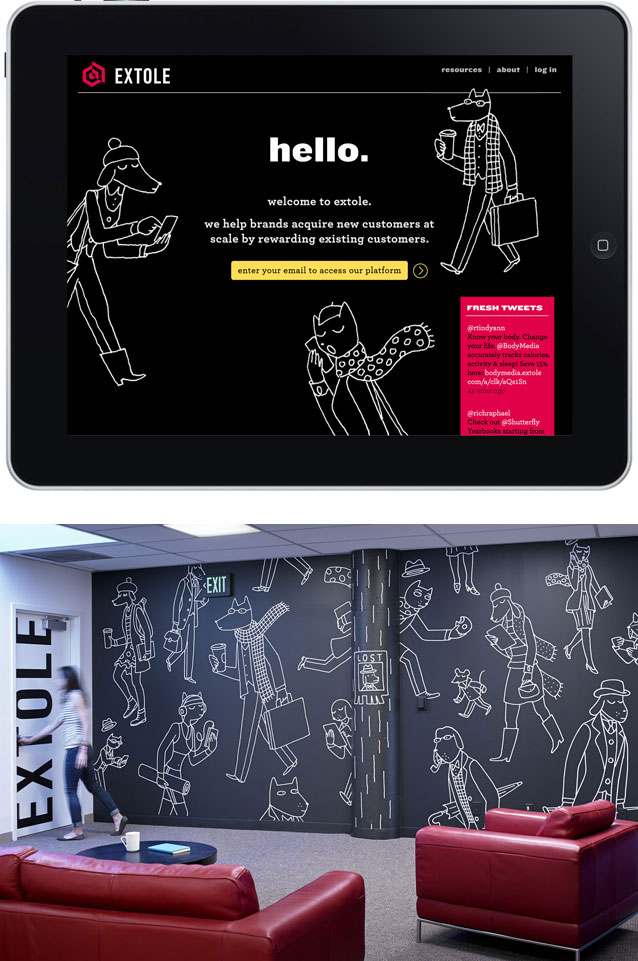
We recently redesigned the identity and online presence for Extole, a San Francisco referral marketing company specializing in new customer acquisition for its clients. We sought to humanize the “virtual” and data-driven aspects of Extole’s business by working with Los Angeles illustrator Greg Clarke to create idiosyncratic depictions of potential new customers as dogs and cats—with the occasional mouse and chimp thrown into the mix.

Business cards feature pairs of animals “sharing:” talking, listening to the same music, or exchanging information; screen printed mugs with a cat and poodle in conversation are given out to clients as a pair. Greg’s illustrations combined with the black and Day-Glo pink color palette work to create a memorable identity for Extole.

Photography by Mark Serr; Environmental photography by John Sutton.


+ SHARE Tags Play : Work

3 March, 2014

AIGA 100 Years of Design: 1914–2014

plog_03_MAR_ 2014

To celebrate the American Institute of Graphic Arts’ centennial, the AIGA asked 100 designers to create “a piece of artwork that makes a social, political or cultural statement about one year from AIGA’s history.” Mark chose the year 1958 so he could work with Gerald Holtom’s timeless symbol for Nuclear Disarmament—what would eventually become known as the “Peace Sign.” All 100 designs from the project can be seen on the AIGA site.

+ SHARE Tags Play : Work/Symbols

10 February, 2014

Play at Play: Happy Chinese New Year!

plog_10_FEB_2014

 Why, sometimes I’ve believed as many as six impossible things before breakfast. —The White Queen to Alice

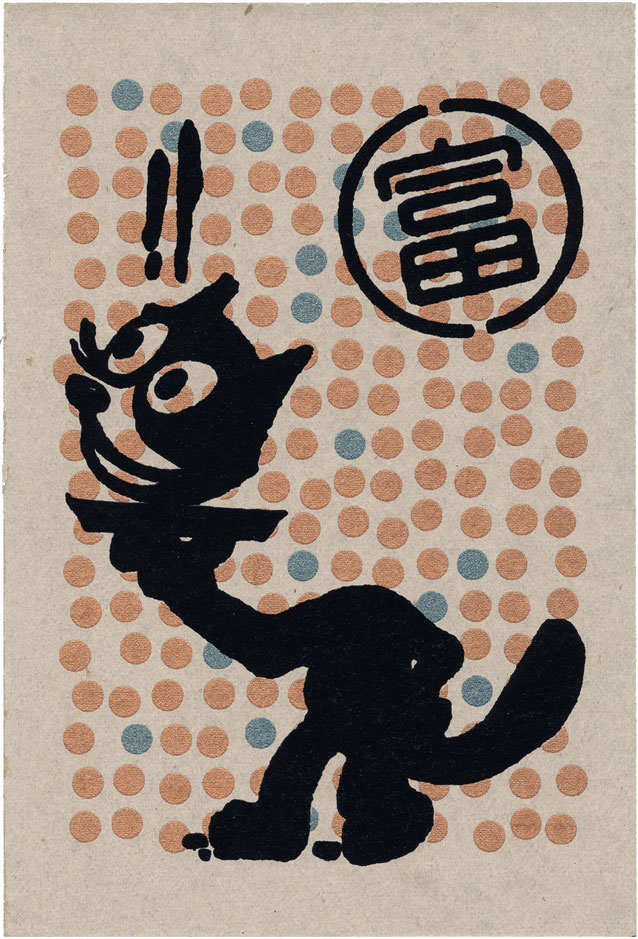
We are committed fans of the impossible here at Design is Play. In fact, our very existence as print designers in twenty-first century San Francisco seems dubious at times, but we intend to thrive here nonetheless. For those of you whose Chinese is a little rusty, the character in the upper-right corner of our card reads wealth. We wish our friends and colleagues much success in this New Year, regardless of the persistence of the “Print is Dead” crowd.

As with our 2013 Valentine, our New Year card was screen printed by Kevin Giffen at Wranch Studio in Santa Monica, California. Kevin printed the design in three colors: two metallics and a black on a ridiculously heavy chipboard stock. Angie set the Lewis Carroll passage on the back of the card in Marian 1742, a monoline slab serif and close relative of Marian Black, the face we used for our Valentine.

+ SHARE Tags Play : Work/Favorites

Tags

  • Recent Posts
  • Play : Work
  • Play : Press
  • Play : School
  • Agitprop
  • Symbols
  • Typography
  • Playmates
  • Favorites
  • Books
  • Book Reviews
  • Interviews
  • Articles
  • Archive
Older
Newer

©2026 Design is Play. All Rights Reserved.